
'The risk is in not being invested and missing out on an upmove.'

The diesel car becomes too expensive with BS-VI and market assessment says the customer will not buy it at that price, says R C Bhargava, chairman, MSIL. He expects buyer preference to change swiftly in favour of petrol, CNG, and other alternative technologies.

'More than one brand in a showroom is too risky because customer loyalty in this market is low. Most people don't drive different cars made by the same manufacturer for a lifetime, they experiment.'

Maruti Suzuki India's net profit surged 80.3 per cent to Rs 3,716.5 crore in the September quarter, driven by better sales, softening commodity prices, cost reduction efforts and higher non-operating income. The company had delivered a net profit of Rs 2,061.5 crore in the year-ago period, Maruti Suzuki India said in a statement on Friday. Maruti said it is expecting the affordability of small cars in the domestic market to come back in the next 2-3 years in the face of rising income levels of people and a growing economy, among others.
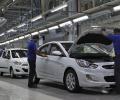
Passenger vehicle wholesales crossed the 10-lakh mark for the first time ever in the June quarter riding on the back of robust demand for utility vehicles, industry body SIAM said on Friday. Total dispatches of passenger vehicles in the first quarter stood at 10,26,006 units, up 3 per cent as compared with 996,565 units in April-June FY24. Utility vehicle sales rose 18 per cent to 645,794 units in the first quarter as against 547,194 units in the year-ago period.

Three months after its launch, Maruti Suzuki's multi-purpose vehicle, Eeco, has notched sales figures of over 7,000 units a month.

Private sector banks have jumped on to the bandwagon to offer better rates than Maruti Udyog for its best-selling car, Maruti 800.

The country's largest automobile maker Maruti Suzuki India (MSI) on Monday said it will hike prices of its cars in the second quarter of the current fiscal due to increase in the input costs. "Over the past year, the cost of the company's vehicles continue to be adversely impacted due to increase in various input costs. "Hence, it has become imperative for the company to pass on some impact of the above additional cost to customers through a price rise," Maruti Suzuki India said in a regulatory filing.

Although it has not announced the price bookings, sources say it could be in thousands.

General Motors India on Tuesday increased vehicle prices by up to Rs 61,000 in order to partially offset the impact of rising input costs and expiry of reduced excise duty concessions.
The car has a good balance of ride and handling, excellent packaging, good performance and is priced competitively.
Maruti Udyog on Tuesday launched a Euro-III variant and a new Euro-II version of Maruti 800, sporting a higher price tag, and said the entry level car was not being phased out.

It's a zippy, well-engineered ride that offers comfort, quality, low cost of ownership and fuel efficiency at affordable prices, says Pavan Lall.
Automakers Maruti Suzuki, Mahindra & Mahindra and Audi India on Monday announced plans to hike prices of their passenger vehicles in January 2024 citing reasons, including cost pressure driven by overall inflation and increased commodity rates. Besides, Tata Motors and Mercedes-Benz India are mulling increasing the prices of their models from January. The country's largest carmaker Maruti Suzuki India, which sells a range of vehicles from entry-level small car Alto to multi-utility vehicle Invicto, priced between Rs 3.54 lakh and Rs 28.42 lakh (ex-showroom Delhi), on Monday said the price hike would vary from model to model.

'Bharat has been leading, but it cannot carry India as the bulk of the sales come from India in terms of volume and profitability.'
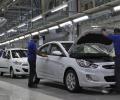
Passenger vehicle wholesales in India touched a record high of 42,18,746 units in the financial year 2023-24, registering a year-on-year growth of 8.4 per cent on the back of robust demand for utility vehicles, industry body SIAM said on Friday. As per the latest data issued by the Society of Indian Automobile Manufacturers (SIAM), the overall passenger vehicle dispatches stood at 38,90,114 units in fiscal year 2022-23. Two-wheeler sales were up 13.3 per cent last fiscal at 1,79,74,365 units, as compared to 1,58,62,771 units in the financial year 2022-23.
Faced with rising input costs, Maruti Udyog Ltd on Monday effected a price hike, including on the popular Alto model, but made no changes in the prices of entry-level car M800 and multi-utility Gypsy.

The new car market is estimated at around 30,000 units a year in sales in a good year, whereas the used car market for luxury vehicles is estimated at around 60,000 cars annually.

Once the 21-day lockdown is lifted, which may happen in phases, those who have been contemplating purchasing a car may actually do it, said analysts. Thanks to social distancing norms and rising hygiene awareness, daily commuters may ditch public transport and shared mobility solutions like Ola and Uber. Many are likely to prefer the confines of a car over roughing it up in crowded public transport services such as a metro, local sub-urban trains and buses, they said.

India's biggest car maker Maruti Suzuki said on Tuesday that its vehicle production in September will tumble by 60 per cent due to chip shortage. The company, which had earlier cut down production at its Gujarat plant, said the chip shortage will hit production in Gurugram and Manesar plants, effectively forcing the automaker to cut production by 60 per cent. Owing to a supply constraint of electronic components due to semiconductor shortage, the company is expecting an adverse impact on vehicle production in September in both Haryana and its contract manufacturing company, Suzuki Motor Gujarat Pvt Ltd. (SMG) in Gujarat.
Carlos Ghosn has appointed small-car specialist Gerard Detourbet to design one specially for India.

When it comes to the replacement of old tyres with new ones, car owners are in a catch-22 situation, wondering about the tyre brand, price and most importantly, tyre warranty.

Carmakers fear an increase of Rs 35,000-40,000 per vehicle for safety equipments.
Best cars selected by enthusiasts and owners across 10 different categories.
Country to witness spate of small and affordable auto launches in next 18 months.

The 800cc five-speed manual transmission comes with a fuel economy of 25.17 kmpl

Automobile retail sales in the country fell 18 per cent year-on-year in the 42-day long festive period this year as semiconductor shortage impacted production across companies affecting their ability to supply adequate numbers to dealer partners, FADA said on Thursday. During the period under review, barring three-wheeler and commercial vehicles, all other segments including passenger vehicles, two-wheelers and tractors were down as compared with the same period of last year. As per data collated by the Federation of Automobile Dealers Associations (FADA), total retail sales across segments stood at 20,90,893 units this festive period, down 18 per cent from 25,56,335 units in 2020.

The pre-owned vehicles arm of the Mahindra Group plans to add 30 outlets in a few days taking the total number to 1,000.

American car maker General Motors on Thursday said it has shelved plans to launch small car in India that was planned to take on Tata Motors' 'Nano', citing viability issues.

Seven years after it announced Nexa, there's no mistaking the seriousness with which Maruti wants the segment to grow, says Pavan Lall.

A study by second-hand car dealer CARS 24 showed 42 per cent of the consumer feel the need for a car to travel safely now. Those who used cabs to commute before the pandemic want to buy a car for the family and a two-wheeler for shorter runs.

Those that are developing quadricycles from scratch say it will take them at least two years to roll them out.
The cars mentioned here do not include facelift, new variants or upgrades of any existing car.
The cars mentioned here do not include facelift, new variants or upgrades of any existing car.

India wasn't applying widespread crash testing like foreign countries do, so manufacturers didn't see the need for an investment focus on safety. Customers rarely walked into showrooms asking for the safest car. They wanted the cheapest or the most fuel-efficient or the best-looking car.

The price differential has been upwards of 20%.

Be it in terms of looks, features or safety, the Indian auto market is growing up

Toyota Motor Corporation and Honda Motor Corporation plan to make India a hub for sourcing components of small cars.

Maruti Suzuki India on Monday said it has hiked prices of its vehicles across models by about 1.1 per cent. This is the second price hike that the carmaker is undertaking in the ongoing fiscal year, after increasing it in April 2022. In December last year, the company had said it would hike prices of its vehicles to offset the impact of rising input costs and make provisions to update the model range to conform to stricter emission norms which will kick in from April 2023.
 © 2026 Rediff.com - Advertise with us - Disclaimer - Privacy Policy - Sitemap - Feedback - About us - Terms of use - Grievances